








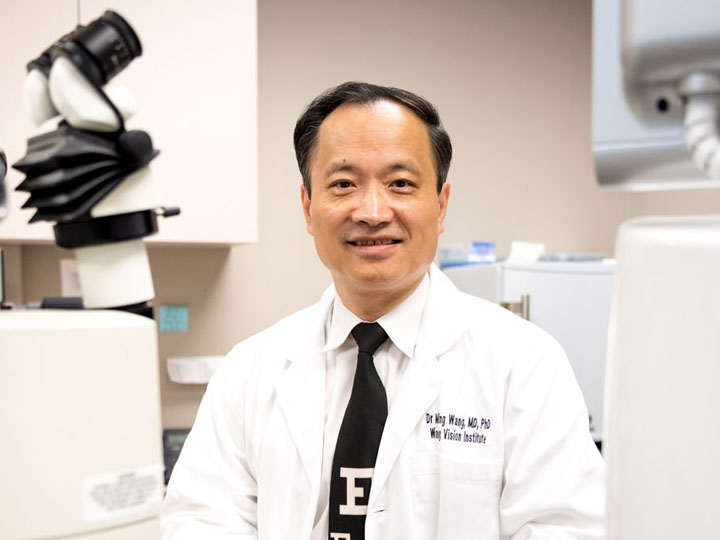
"After age 40, every year, the distance that we can read things clearly begins to recede from us," said Ming Wang, M.D., Ph.D., ophthalmologist at Wang Vision Cataract & LASIK Center.
As we age, the lens inside our eye ball grows, but the eyeball doesn't. A tighter quarter around the lens makes it harder to focus. In a new procedure, surgeons implant four curved plastic spacers the size of a grain of rice within the wall of the eye ball, giving the lens space to change shape and focus.
Molly Stewart had the surgery one week ago. It improved her vision from 20-100 to 20-40.
"I can already tell a difference when they're doing the eye tests on me, when I can read below the average line," explained Stewart.
Dr. Ming Wang said the surgery takes 15 to 20 years off the eye. Huskey's vision also improved to 20-40.
"Oh it's just fun to think I can see as good as I could when I was in my mid-20s," said Huskey.
Now, she's back focusing on more important things than finding her glasses.
To qualify for the Scleral spacing procedure, patients must be 50 to 60 years old with no prior eye surgeries and good vision aside from reading glasses. Only three centers in the United States are performing the experimental surgery - in New York, Chicago and Nashville. If the patient doesn't like the outcome, the surgery can be reversed.
RESEARCH SUMMARY:
ABOUT PRESBYOPIA: Just like gray hairs and wrinkles, the ability to see things up close is an unavoidable part of aging. This condition is referred to as presbyopia and occurs when the crystalline lens of the eye loses its elasticity. This makes it difficult for the lens to change shape in order to focus on near objects. The effects of presbyopia normally take place over a number of years and become noticeable in the early to mid-40s. Since the condition is a normal part of the aging process, it cannot be prevented, according to the American Optometric Association. Signs of presbyopia include blurred vision at normal reading distance, eye fatigue and headaches when doing close work.
TREATMENT: To help correct the effects of presbyopia, an optometrist may prescribe reading glasses, bifocals, trifocals or contact lenses. Changes in eyewear will probably be necessary since the effects of presbyopia continue to change the ability of the crystalline lens to focus. Another option is corneal implants. Though no such treatments have been approved by the FDA for use in the United States, a number of companies are conducting clinical trials to evaluate implants and inlays.
SCLERAL SPACING PROCEDURE: Ming Wang, M.D., Ph.D., is an ophthalmologist at the Wang Vision Cataract & LASIK Center in Nashville -- one of three centers in the United States conducting a clinical trial on a new treatment for presbyopia. It's called the scleral spacing procedure (SSP). It involves placing four scleral expansion bands -- tiny plastic spacers the size of a grain of rice -- into the scleral, or white, part of the eye. The spacers create an additional space for the eye to change shape and focus. The technique does not affect a patient's existing vision. It's also reversible, should the segments need to be removed for any reason. Dr. Wang says SSP takes up to 20 years off a patient's eyes.
"We have shown that perhaps, just perhaps, human beings can now get one step closer to one of the ultimate dreams in medicine -- one of the ultimate dreams as a human being -- that is to have our youth restored," said Dr. Wang.
Three-hundred patients will take place in the U.S. FDA study of SSP. The value of the surgery is estimated to be $10,000, though it's free of charge to patients in the study. To qualify for the clinical trial, patients must be between the ages of 50 and 60, have had no prior eye surgeries or eye conditions, and have good distance vision, needing only correction for up-close vision.